
Six labourers died and three were injured when part of an under-construction bridge collapsed in Hamirpur, Uttar Pradesh, following a storm. The incident occurred early Friday morning as labourers slept on a slab of the bridge.

The weather office has warned that the prevailing monsoon conditions could trigger flash floods, landslides, waterlogging and a further rise in river levels across the Northeast.

The death toll from flash floods in central Nepal has surged to 734, with nearly 2,500 people still missing. India has intensified its rescue and relief efforts, sending additional aid, technical teams, and forensic experts, while also working to locate and rescue over 275 missing Indian nationals.

"Rather than worrying, preparation is required. Contingency plans will be made for affected districts and crop changes will be considered wherever necessary"

The India Meteorological Department (IMD) reports that ash clouds from volcanic activity in Ethiopia, which impacted flight operations in India, are drifting towards China and will move away from India by 7.30 pm on Tuesday.

Mahindra & Mahindra (M&M) is expanding its farm equipment strategy beyond tractors to include a wider range of mechanisation solutions like harvesters, balers, seed drills, and telematics-enabled services, aiming to capitalise on the growing demand for rental services by rural entrepreneurs and address low mechanisation levels in Indian agriculture.

The devastating flash floods wreaked havoc across Nepal, with the ministry of external affairs on Thursday stating that 84 Indian nationals have been rescued while 290 remain uncontactable as the Himalayan nation stepped up search, rescue and relief operations following the disaster that has claimed more than 390 lives.

A severe cold wave has gripped North India, with temperatures plummeting to near-freezing levels in several areas. The cold wave has disrupted daily life, with dense fog affecting visibility and forcing people to stay indoors.

A poor monsoon could drag overall economic growth and compound the impact of the West Asia conflict on the Indian economy.

Torrential monsoon rains unleashed widespread destruction across several parts of the country on Thursday, inundating roads, uprooting trees, damaging property and disrupting normal life as authorities scrambled to restore normalcy.

The civil aviation ministry is monitoring the impact of volcanic ash plumes from Ethiopia on flight operations, leading to cancellations and delays. The situation is being closely monitored, and necessary precautions are being taken.

The death toll from devastating flash floods in Nepal has surged to 1,252, with more bodies recovered and fresh flood risks emerging due to continuous rainfall in the Bhotekoshi River's upstream areas. The disaster, triggered by an ice-rock avalanche, has also left 4,875 people missing and prompted calls to address climate change's impact on the Himalayan region.

Nepal's devastating flash floods have claimed 1,127 lives, with thousands still missing a week after the disaster. Rescuers are intensifying efforts to find survivors and recover bodies across affected regions, while police work to identify victims and relocate families from high-risk areas.

The India Meteorological Department (IMD) has predicted below normal monsoon rains for India this year, citing the potential emergence of El Nino conditions. This could significantly impact the country's agriculture-dependent economy.

Earthquake tremors were felt in Kolkata and adjacent districts of West Bengal after a 5.5 magnitude earthquake jolted parts of Bangladesh. People rushed out of buildings in panic, but there were no immediate reports of damage or casualties.

High levels of ultraviolet (UV) radiation have been recorded across Kerala, prompting warnings from the Kerala State Disaster Management Authority (KSDMA). Residents are advised to take precautions to avoid prolonged exposure, especially during peak hours.

Large parts of India are experiencing a severe heatwave, with temperatures soaring to dangerous levels. Authorities have issued alerts and health advisories as the heatwave intensifies across multiple states.
Unseasonal rainfall could damage standing wheat crops, especially late-sown fields nearing maturity and grain-filling stages.

Mumbai has spent four centuries building folklore around its monsoon: The potholes, the delayed trains, the office debates about whether it will 'break' this week or next. It turns out the rain was always a market. Nobody had built the exchange for it until now!

Heavy rains and thunder returned to Mumbai, causing significant delays in local and long-distance train services, particularly affecting routes towards Gujarat and Pune. Two key reservoirs, Tulsi and Vihar lakes, have begun overflowing, though the city's overall water stock remains at 41.43 per cent.

The IMD is predicting close to a 60% probability of deficient rainfall, which means there is a strong possibility that the monsoon this year will be poor.

Scientists are examining how a possible glacial collapse and ice-rock avalanche may have triggered the devastating flash floods along Nepal's Bhote Koshi River, with preliminary assessments indicating that debris may have temporarily blocked the Lhende River and created a landslide dam that subsequently gave way.

'During the hot season (April to June), above-normal minimum temperatures are likely over most parts of the country, except in some regions of Maharashtra and Telangana, where minimum temperatures are expected to be normal to below normal,' IMD said.

Nepal is grappling with one of its worst disasters in recent years as massive flash floods, triggered by an ice avalanche, have claimed 270 lives and left thousands missing across multiple districts, prompting urgent rescue and relief operations.

JPMorgan has downgraded Indian equities to 'neutral' from 'overweight', citing elevated valuations, rising earnings risks, and limited exposure to next-generation technology like AI. The brokerage believes other emerging markets offer more attractive risk/reward propositions despite India's strong structural growth story.

A massive flash flood originating in Tibet has devastated central Nepal, killing 17 people and leaving nearly 500 missing, including 105 Indians. The deluge, caused by a rock slide near the Nepal-Tibet border, swept through districts, washing away bridges and severely damaging at least a dozen hydropower projects.

Delhi experienced a foggy morning with a dip in temperature and improved air quality following recent rainfall. The air quality index (AQI) reached 'satisfactory' levels for the first time in five months.

Heavy monsoon rains have severely impacted Mumbai and its surrounding areas, leading to landslides, suspension of train services, and at least 13 fatalities over the past few days. The Mumbai-Pune Expressway was also shut due to a concrete pillar collapse and waterlogging.

Prime Minister Narendra Modi has urged Indian citizens to take precautions during the ongoing heatwave, emphasising hydration and care for vulnerable individuals and animals.

Mumbai experienced heavy overnight monsoon rains, with some areas receiving over 200 mm in 24 hours, leading to widespread waterlogging, traffic congestion, and disruptions in suburban train services, particularly on Central Railway lines due to a track cave-in.

Schools in Delhi are taking precautionary measures to protect students from the ongoing heatwave, including suspending outdoor activities, shifting assemblies indoors, and considering early closure for junior classes.
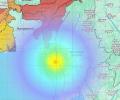
An earthquake of magnitude 6 with its epicenter in Myanmar jolted Kolkata and its adjoining areas, causing tremors and concern among residents.

A new western disturbance brought thunderstorms and rain to parts of northern India, with hailstorms and snow reported in several regions. The weather caused flooding in Jammu and Kashmir and prompted a yellow alert in Delhi.
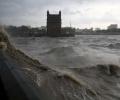
The wind speed, reaching 45-55 kmph and gusting to 65 kmph, is likely to prevail over the North Maharashtra coast between October 3 and 5.

On the weather front, dense fog led to a sharp drop in visibility, with Palam recording 50 metres visibility under dense fog conditions with west-southwesterly winds at 5 kmph at 8 am, while Safdarjung reported 100 metres visibility with calm winds at the same time.

The India Meteorological Department (IMD) has issued a 'red alert', warning of extremely heavy rainfall in Mumbai, Thane, Raigad and Palghar districts on Sunday, extending the wet patch in the region.

Delhi recorded its coldest January morning in three years with the minimum temperature dropping to 3 degrees Celsius. Cold wave conditions are expected to persist, and air quality has deteriorated to the 'very poor' category.

The winters could be cooler in the plains due to the prevailing La Nina conditions though it does not have a direct relationship and also due to influence of the polar vortex.

Dense fog disrupted operations at Delhi airport, leading to cancellations and delays of hundreds of flights. Airlines are offering refunds and rescheduling options.

Several parts of Mumbai received heavy rainfall in the last 24 hours, with Vikhroli reporting the highest downpour. The IMD reported significant rainfall in various areas of the city.
